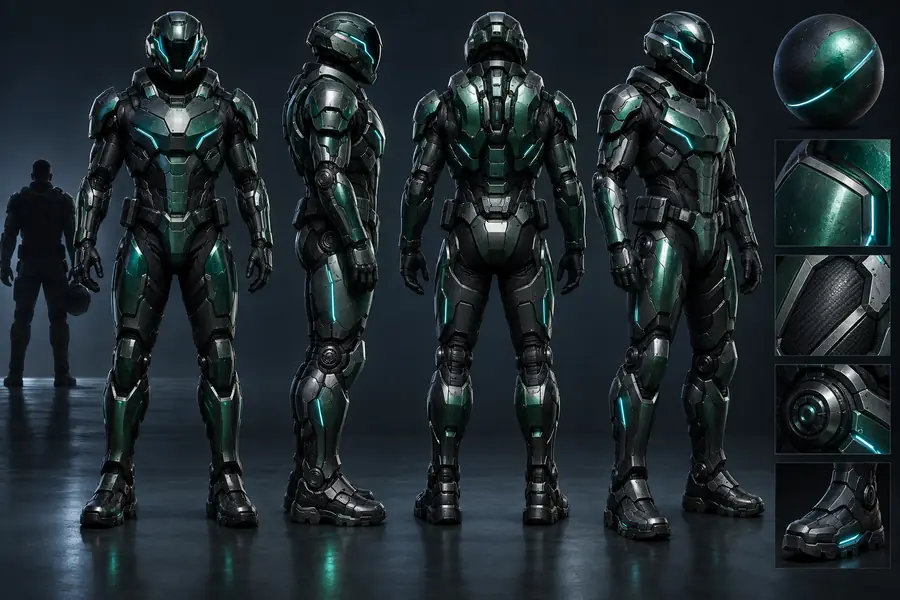
pixal3d comfyui can feel difficult when every node, model file, and output setting must line up before you see a usable asset. Start with a focused workflow and refine only what affects the result.
The hard part is rarely the idea. It is choosing the right route for the input, keeping the graph understandable, and knowing whether a rough output needs better prompting or a different workflow.
Three concrete pixal3d comfyui workflows
These patterns keep the graph small enough to debug while giving you clear places to improve geometry, appearance, and export readiness.
Concept artist
You have a short visual brief but no finished reference image. Use a text prompt to establish the subject, silhouette, material, and camera-independent shape.
You get a fast blockout that can guide later sculpting, retopology, or visual development. The [pixal3d github](/pixal3d-github/) route is useful when you want to inspect the surrounding project context.
You have a product photo, sketch, or turntable frame and need a 3D starting point. Keep the reference clean, centered, and separated from distracting background detail.
The resulting mesh has a more controlled visual target, making it easier to judge proportions before adding materials. Compare this with [picture to 3D](/picture-to-3d/) for a broader image-led process.
You need several variations of a prop or environment object. Lock the subject category and style, then change one attribute at a time across the batch.
Consistent prompts make the outputs easier to compare and reduce the chance that every variation becomes a completely different object. The [pixal3d online free](/pixal3d-online-free/) route can help with quick early experiments.
You want a repeatable graph rather than a one-off generation. Separate input preparation, pixal3d inference, preview inspection, and export into visible stages.
A staged graph makes failures easier to isolate and gives your team a shared place to tune prompts, resolution, and cleanup decisions. Review [pixal3d gguf](/pixal3d-gguf/) if local model format is part of the setup.
Treat the graph as a small production line. Each stage should answer one question before the next stage adds complexity.
1
Prepare the input
Write a compact prompt or select one strong reference image. Describe the object, viewpoint-independent features, materials, and intended level of detail instead of stacking unrelated style words.
2
Run and inspect
Connect the pixal3d stage to a preview output, then inspect silhouette, missing surfaces, thin parts, repeated details, and obvious topology problems before attempting another variation.
3
Clean and export
Choose the strongest candidate, apply the minimum cleanup needed for your downstream tool, and record the prompt and settings so the result can be reproduced or compared later.
Example output
A good first pass is not judged only by whether it looks attractive. Compare the source intent with the generated structure and identify the next specific correction.
Reference intent
Generated scene direction
Use the pair to check whether the generated form preserves the subject, scale cues, and major visual landmarks before spending time on polish.
Workflow checkpoints
1Prompt or reference image chosen before the graph runs
01input
2Prepare, inspect, and clean as separate decisions
03stages
3Silhouette, surfaces, details, and export readiness to review
04checks
4Do not treat a visually pleasing preview as production-ready by default
0assumptions
Compliance notes
A ComfyUI route gives you control, but control also means you are responsible for the inputs, model sources, and outputs you pass through the workflow.
It cannot guarantee clean topology
A convincing preview may still contain dense, uneven, intersecting, or poorly organized geometry. Plan for inspection and cleanup before using the asset in a serious scene.
WorkaroundUse the output as a blockout or pass it through your normal retopology and mesh-validation tools.
It cannot resolve ambiguous references
A single image does not reveal every hidden surface, exact depth, or mechanical relationship. The workflow must infer what is not visible.
WorkaroundProvide multiple consistent views or use a simpler object with clearly described structure.
It cannot grant rights to source material
ComfyUI does not make an image, prompt, model, or generated asset automatically safe to publish. Ownership, licenses, trademarks, and likeness concerns remain separate questions.
WorkaroundUse inputs and model resources you are permitted to use, and document provenance for shared projects.
It cannot make every local setup identical
Hardware, node versions, model files, memory limits, and custom extensions can change the result or prevent a graph from running.
WorkaroundKeep dependencies documented, test a minimal graph first, and change one environment variable at a time.
Scenario FAQ
Answers to the practical questions people usually ask before connecting pixal3d to a ComfyUI workflow.
It can be approached as part of a ComfyUI-style node workflow when the required model, node, and runtime components are available for your environment. The exact connection depends on the implementation and compatible files, so verify the current project instructions before building a large graph.
Start with one input, one generation stage, and one preview or save stage. This minimal graph lets you confirm that the model loads and produces an output before you add image conditioning, batching, enhancement, or export steps.
An image-led workflow may be suitable when the reference has a clear subject, centered framing, and enough visible detail to infer shape. It will not recover hidden geometry with certainty, so multiple views or manual corrections may still be necessary.
Usually, you should treat the first output as a generated starting point rather than a finished production asset. Check topology, scale, materials, naming, polygon density, UVs, and licensing before placing it into a shipped project.
Variation can come from prompts, seeds, model versions, node settings, input preparation, and hardware or runtime differences. Record the graph, model files, seed, and key settings whenever you produce a result worth keeping.